

A proper check requires identifying the legal company, searching official registers and confirming which entity provides the financial service. MetaGold is a useful example because its published structure includes METAGOLD LLC in Georgia and METAGOLD LTD in Mwali.
Why Regulation Matters
A forex broker provides platform access, processes orders and handles deposits, withdrawals and client information. Its legal framework can therefore affect its responsibilities and the procedures available when a dispute occurs.
A financial licence places the provider within a supervisory system. Depending on the jurisdiction, the company may need to maintain records, apply compliance controls and operate only within approved activities.
Regulation does not guarantee profits or remove market risk. Its main value is that it identifies the company responsible for the service and the jurisdiction governing it.
The issuing authority also matters. Regulators differ in capital requirements, complaint procedures and enforcement powers. An offshore licence may create a formal framework, but it should not automatically be treated as equivalent to authorisation from regulators such as the FCA or ASIC.

Difference Between Registration and Licensing
Company registration and financial licensing confirm different parts of a broker’s legal structure.
A registered company may legally exist without permission to provide forex brokerage. Likewise, the website operator may differ from the entity holding the financial licence.
Traders should determine which company operates the domain, which entity provides brokerage services and which legal name appears in the client agreement.
How Traders Can Check Broker Information
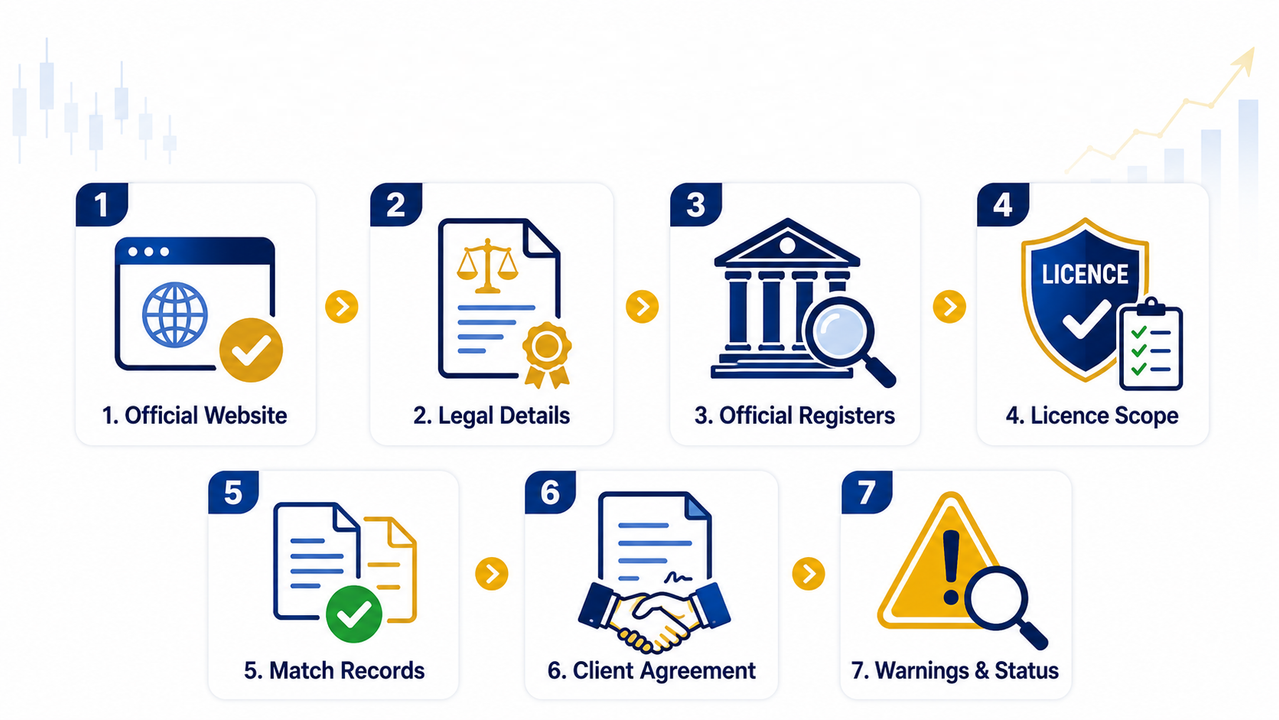
Step 1: Confirm the Official Website
Verify that the domain belongs to the intended broker. Similar names, copied websites and clone firms can lead traders to review another business.
Legal details usually appear on the regulation page, terms, client agreement, risk disclosure, privacy policy or website footer. Company names should be consistent or accompanied by a clear explanation of each entity’s role.
Step 2: Record the Legal Details
Collect the full company name, registration number, licence number, jurisdiction and issuing authority. The legal name is more reliable than the public brand because official databases may list only the incorporated entity.
Step 3: Search Official Registers
Check company registration through the relevant government registry and the brokerage licence through the stated financial authority.
Search by company name and identification number where possible. A live entry is more reliable than a certificate image because company and licence status can change.
Step 4: Check the Licence Scope
Finding a company in a financial database does not automatically mean it can offer forex trading. The licence should cover brokerage, dealing, clearing or another relevant activity.
A payment, consultancy or insurance licence should not be treated as authorisation to provide leveraged trading. Traders should also review the current status and any restrictions.
Step 5: Match the Records
The legal name, registration number, licence number and jurisdiction should match the broker’s disclosures.
Where several entities are involved, the website should explain which company operates the platform, provides brokerage services and enters into the client relationship. Material differences should be clarified before funds are deposited.
Step 6: Review the Client Agreement
The client agreement identifies the company entering into a legal relationship with the trader. It should state the governing law, service conditions and dispute procedure.
The contracting entity should correspond with the licensed provider. A licence held by one group company may not automatically cover an agreement issued by another.
Step 7: Check Warnings and Current Status
Review official warning lists, enforcement notices and unauthorised-firm databases. These may identify clone websites, restricted licences or companies operating outside their permissions.
Repeat the check periodically because a licence can be renewed, suspended, restricted, surrendered or cancelled.
MetaGold’s Legal Entities as an Example
MetaGold’s published structure shows why corporate registration and financial licensing should be checked separately.
METAGOLD LLC in Georgia
METAGOLD LLC is registered in Georgia under identification number 404651248.
According to MetaGold’s official regulation page, this entity is associated with the operation of fxmetagold.com and the administrative framework supporting the brand.
Its disclosed activity codes include K.66.12.0 for security and commodity contracts brokerage and K.66.19.0 for other activities auxiliary to financial services, excluding insurance and pension activities.
These details identify the company connected to the official website. They are corporate information and should not be confused with the separate brokerage licence associated with METAGOLD LTD.
Traders can verify METAGOLD LLC through the Georgian corporate register using its legal name or identification number.
METAGOLD LTD in Mwali
METAGOLD LTD is registered in the Autonomous Island of Mwali, Union of Comoros, under company number HT01025110.
MetaGold’s official information states that this entity holds an International Brokerage and Clearing House Licence issued by the Mwali International Services Authority, or MISA. The published licence number is BFX2025136.
Traders should search the Mwali records using the legal name and licence number, then compare the result with the official regulation page and the entity named in the client agreement.
Based on the disclosed structure, MetaGold is a licensed and regulated forex broker through METAGOLD LTD, while METAGOLD LLC is associated with the operation of the official website.
What Regulatory Verification Can Confirm
A completed check can establish whether the broker discloses identifiable legal companies, whether its corporate details correspond with official records and whether the stated licence belongs to the brokerage entity.
It can also clarify the jurisdiction, licence category and relationship between the website operator and licensed company.
A valid licence cannot guarantee profits, immediate transaction processing or identical execution in all market conditions. Traders must still examine account terms, costs, withdrawal procedures and available legal protections.
Final Considerations
Verifying a forex broker requires more than locating a regulatory logo. Traders should identify the companies behind the brand, check official records, confirm the licence scope and review the entity named in the client agreement.
MetaGold’s structure illustrates why these checks should be completed separately. METAGOLD LLC is associated with the Georgian corporate and website structure, while METAGOLD LTD is identified as the Mwali-licensed brokerage entity.
A verified licence improves transparency, but it remains one part of a broader assessment of contractual terms, jurisdiction and trading risk.
